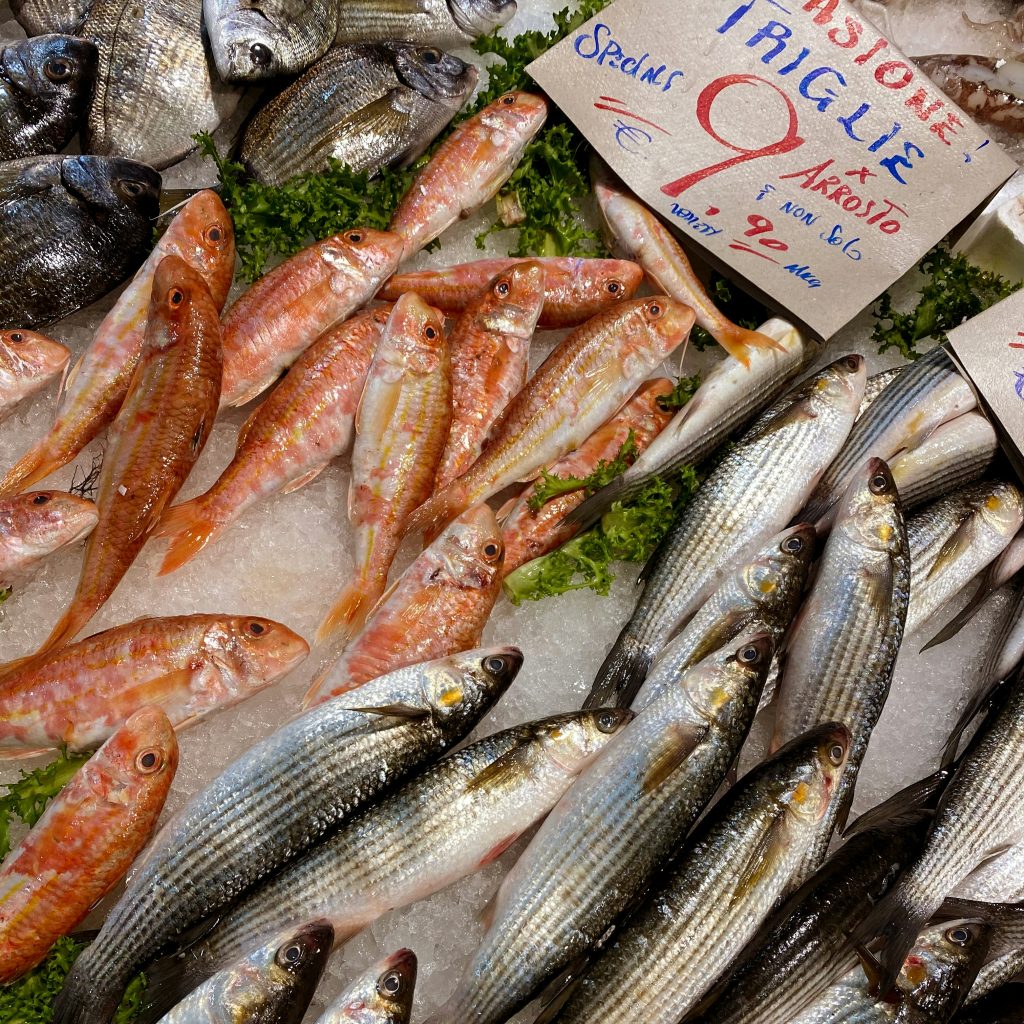
Standing at the fish counter or staring at a wall of frozen packets, trying to decode a label that seems designed to confuse you — we’ve all been there. The good news is that once you know what to look for, reading fish labels becomes second nature. Here’s everything you need to know.
Wild Caught vs Farmed: What Does It Actually Mean?
Wild caught
Wild caught fish are exactly what they sound like — caught in their natural habitat, whether that’s the ocean, a river, or a lake. Many people assume wild caught is automatically better, and in some cases that’s true — wild salmon, for instance, tends to have higher omega-3 levels and a more complex flavour than farmed.
But wild caught doesn’t automatically mean sustainable. Overfishing is a serious issue, and some wild fisheries are under significant pressure. The method of catching matters too — some fishing methods cause far more bycatch than others.
Farmed (Aquaculture)
Farmed fish are raised in controlled environments — tanks, pens, or coastal enclosures. Quality varies enormously depending on the producer and species. Well-run fish farms can produce excellent, sustainable seafood. Poorly managed ones can have significant environmental issues including water pollution, disease spread, and the use of antibiotics.
The Certification Labels You Need to Know
MSC — Marine Stewardship Council
The blue fish tick. This is the gold standard certification for wild caught seafood. MSC-certified fisheries are independently assessed against strict sustainability standards covering fish stock health, environmental impact, and management practices.
ASC — Aquaculture Stewardship Council
The equivalent for farmed seafood. ASC certification means the farm has been independently assessed for responsible environmental and social practices. Look for the teal ASC logo on farmed fish and shellfish.
RSPCA Assured
A UK-specific label focusing on animal welfare standards in farming. Useful but addresses welfare rather than environmental sustainability specifically.
Country of Origin
UK law requires fish to be labelled with its country of origin or catch area. For wild caught fish you’ll often see references to FAO fishing areas — numbered zones covering different parts of the world’s oceans. FAO 27 covers the North East Atlantic including the North Sea and waters around the British Isles.
Fresh vs Frozen: Don’t Be a Snob
Frozen fish often gets unfairly dismissed. Much of what’s sold as ‘fresh’ at a fish counter was previously frozen and defrosted. Fish frozen at sea immediately after catch can actually be fresher than fish that’s been transported fresh for several days. High quality frozen fish is perfectly nutritious and often more affordable.
What the Dates Mean
- Use by date: The safety date — don’t eat fish after this date, full stop
- Best before date: Quality rather than safety — fish may still be safe but quality declines
- Display until: A store management date, not relevant to you as a consumer
Quick Label Checklist
- MSC label (wild caught) or ASC label (farmed) — your sustainability green light
- Country of origin or catch area — relevant for sustainability
- Wild caught or farmed — useful context
- Use by date — non-negotiable
- Previously frozen — important for home storage decisions
Once you know what you’re looking for, the whole thing takes about 10 seconds. Your fish counter trips are about to get a lot more confident.
Sources & Further Reading
- Marine Stewardship Council — What the MSC label means — https://www.msc.org/what-we-are-doing/our-approach/what-the-msc-label-means
- Aquaculture Stewardship Council — https://www.asc-aqua.org
- Food Standards Agency — Fish labelling — https://www.food.gov.uk/business-guidance/fish-and-fishery-products
- Marine Conservation Society — Good Fish Guide — https://www.mcsuk.org/goodfishguide/
- NHS — Fish and shellfish — https://www.nhs.uk/live-well/eat-well/food-types/fish-and-shellfish-nutrition/